
About Jura
Islands are magical places, each one having its own unique appeal. Whether it’s the adventure of getting there, or that land and sea seem intermingled, it is hard to pinpoint exactly what it is, but Jura is no exception to this rule. Lying just off the Knapdale peninsula on the Argyll mainland, Jura is tucked in between Scarba, Colonsay, Islay and Gigha.
Nestling in the Gulf Stream, these islands, along with the Isle of Mull to the north, enjoy a milder climate than the mainland. This creates a favourable environment for the vast array of wild flowers and fauna that thrive here. With its towering ‘Paps’, Jura dominates the land and seascape for miles around. Although in land area roughly the same size as Islay, Jura’s population is tiny at just over 250 (in comparison to Islay’s at just over 3000). It is easy to see why it is commonly described as one of Scotland’s true wildernesses. Its rugged beauty, abundant wildlife, and its comparative lack of people add to the magic and mystery.
Island of Deer
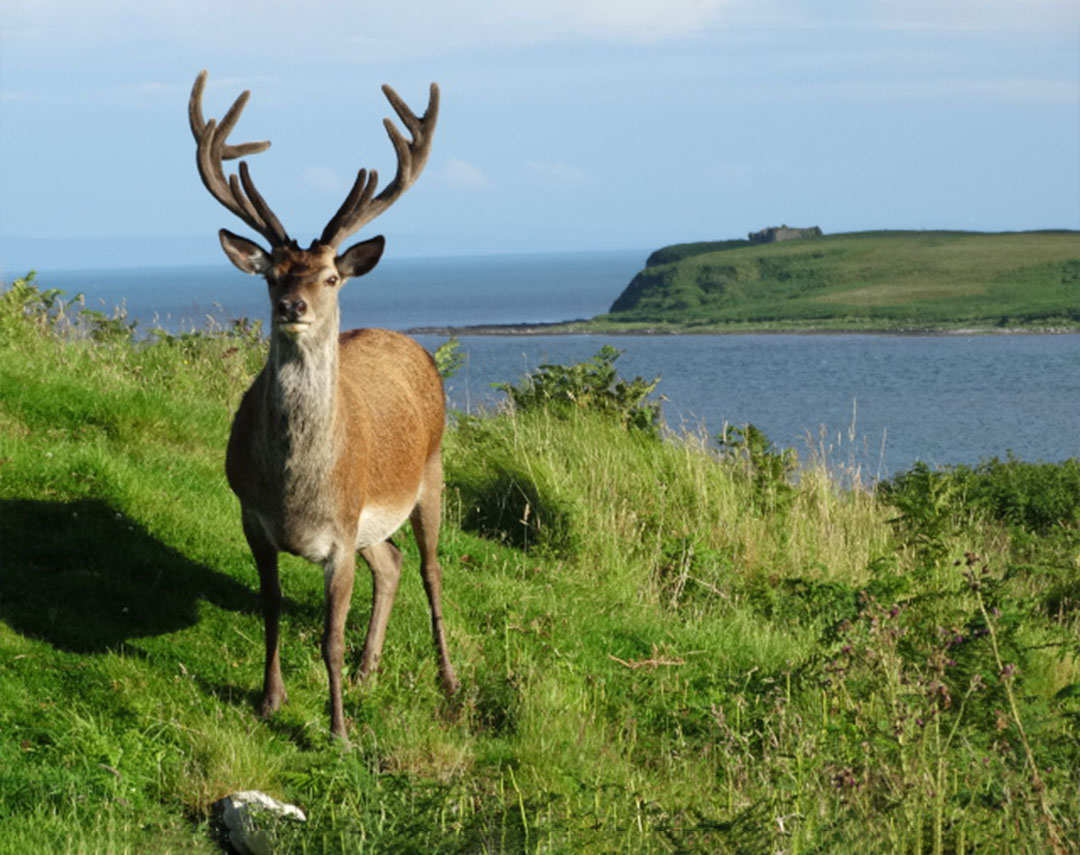
It is widely believed that the name “Jura” comes from the Old Norse word dyr, meaning “island of deer”, a fitting description for an island that is home to around 5,000 red deer. Visitors rarely leave without spotting these magnificent animals, which outnumber the island’s human population many times over. Jura’s rich wildlife extends far beyond its famous deer, with birds of prey soaring overhead, seals basking along the shoreline, wild goats roaming the hillsides, and otters frequently seen around the coast. On a lucky day, dolphins may also make an appearance in the surrounding waters, making Jura a truly special destination for anyone who enjoys the natural world.
The island’s remote west coast is one of its greatest treasures. Largely uninhabited and untouched, it is home to some of the world’s finest raised beaches, where ancient shorelines stand as reminders of Scotland’s changing landscape. Although there are no roads along this rugged coastline, a network of walking tracks provides access to some of Jura’s most spectacular scenery, rewarding those who venture into its peaceful wilderness.
At the island’s northern tip lies the famous Corryvreckan Whirlpool, one of the largest and most powerful tidal whirlpools in the world. It is an unforgettable sight, particularly when the wind and tide combine to create its most dramatic displays. During the summer months, regular boat trips depart from Craighouse, offering visitors an excellent opportunity to experience the whirlpool from the water. Alternatively, those seeking a memorable walk can follow the route of around nine miles from the end of the council road beyond Ardlussa, passing Barnhill, where George Orwell lived while writing his celebrated novel 1984, before reaching the northern coastline.
